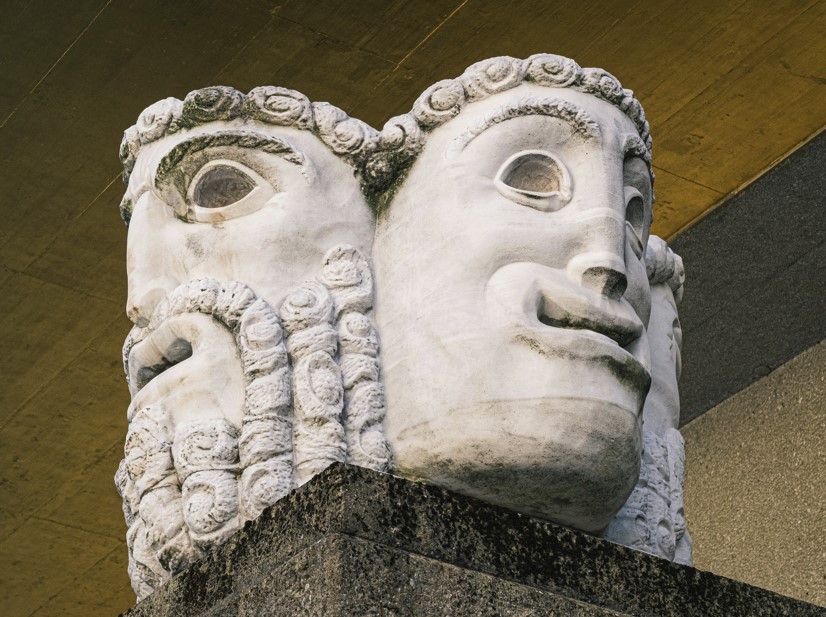
At Carnival, at least you’re honest.
You know you’re wearing a mask. You chose it. You paid good money for it. And at the end of the night, you take it off.
The challenge is the rest of the year.
There’s something I notice in myself and in others, and nobody wants to hear it.
You are rarely yourself.
Not at work. Not in meetings. Not at family dinners. Not in first conversations. Not when someone you admire is in the room. Not when there’s something to lose.
In these moments — which are most moments — what shows up is an edited version. Calibrated. Internally approved before it leaves your mouth. Someone who knows what the situation “requires.” Who adjusts the tone, the vocabulary, the opinions. Who laughs at the right jokes and swallows the wrong ones.
And the worst part isn’t that it happens. The worst part is that it stops feeling like a choice.
Jung called it the Persona. The social mask we build to navigate the world. It’s not necessarily bad — it’s functional. The challenge is when you forget you’re wearing it. When you start confusing the Persona with the self.
Because on the other side is the Shadow. Everything you repressed, everything you decided was unacceptable, everything you learned too early wasn’t welcome. The anger. The ambition. The desire to say no. The exhaustion of being nice.
The Shadow doesn’t disappear. It just gets more expensive to keep hidden.
Donald Winnicott, a British paediatrician and psychoanalyst, observed this in children before any adult could articulate it.
When a child’s environment isn’t safe enough — when love feels conditional, when showing what you feel creates tension, when being “good” is what keeps the peace — the child learns to adapt. They develop a False Self: a functional, presentable version that protects the true self somewhere inside.
It’s an intelligent solution. A four-year-old has no other option.
The challenge is arriving at 35 and still using the same strategy. Still managing impressions. Still measuring what you can say and what stays locked away.
Gabor Maté goes deeper. He says masks aren’t weakness — they’re adaptation. They were the most intelligent response available to you at a moment when you were vulnerable and needed to belong, to be accepted, to survive the environment you grew up in.
The body learns this before the mind does. Before you can even think “should I say this or not?”, your nervous system has already decided for you. You’ve already contracted. Already pulled back. Already smiling when you have no desire to smile.
And that pattern repeats. In meetings. In relationships. In conversations that should be simple.
Here’s what nobody tells you about masks: they cost energy.
A lot. Constantly.
It’s not just the effort of appearing to be someone you’re not. It’s the cognitive work of monitoring what comes out, anticipating how it will land, managing the dissonance between what you think and what you say. It’s chronic exhaustion you attribute to a thousand other things — work, traffic, not sleeping well enough.
Jung’s Shadow doesn’t stay quiet. It collects its debt. In irritability you can’t explain. In distance from the people you love most. In a persistent feeling that you’re living a life that’s slightly beside your own.
I’m not saying you should tell everyone everything you think.
That’s not authenticity — that’s a lack of social intelligence.
I’m saying there’s a difference between choosing to adapt your communication to a context, and not even being able to access what you actually think and feel because the filter runs before you do.
The first is competence. The second is a prison that feels comfortable because you no longer remember anything else.
The question isn’t “do you wear a mask?”
Everyone does. I do. You do.
The question is: do you know when you’re wearing it?
Because Carnival ends. And for the rest of the year you’re either yourself — or whoever you learned to be in order to survive the rest of the year.
Leave a Reply